You open five AI chat tabs in Claude before coffee. One for a customer reply. One for a flyer draft. One for "summarize my week." Another for a second opinion. Then the phone buzzes, the inbox reloads, and you still own every ping.
That is access. It is not a personal assistant with proactive autonomy.
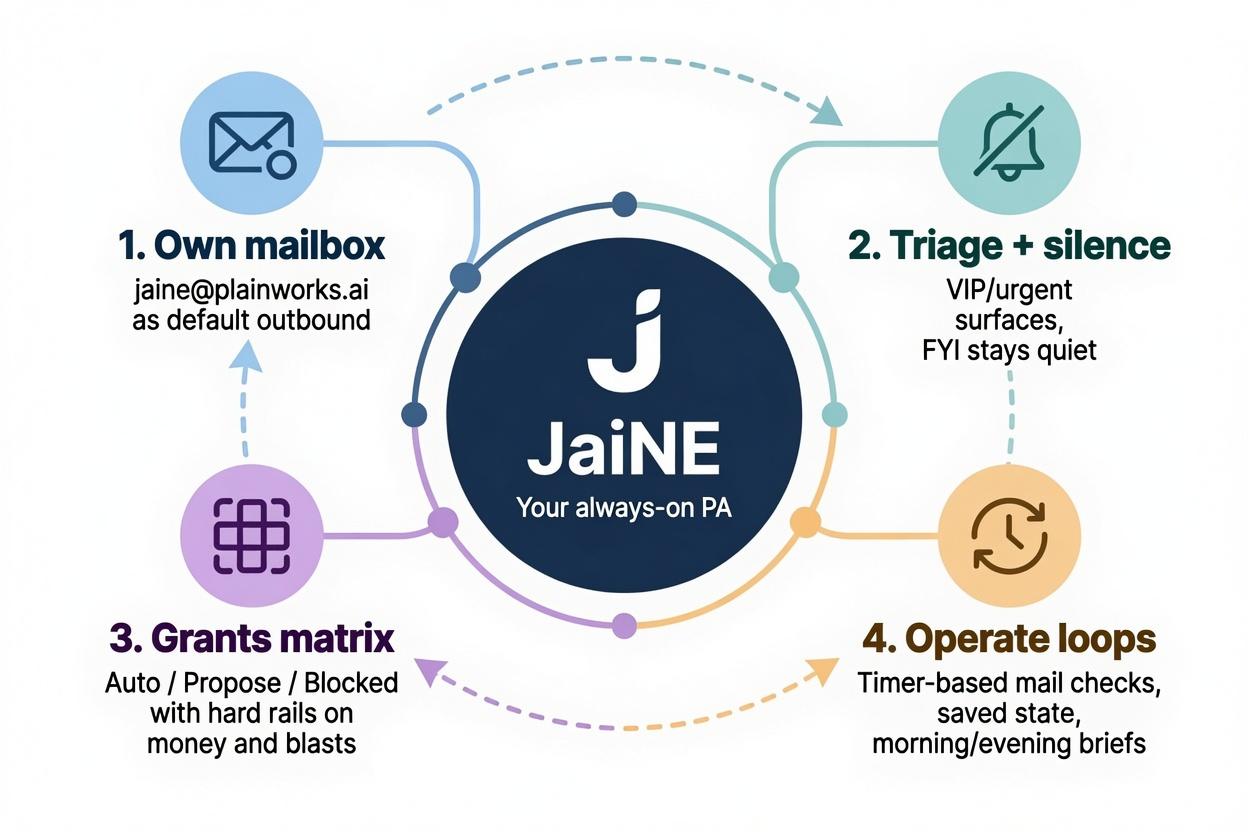
A personal assistant is a role system: a name, a mailbox, written authority and guardrails, and a job that includes keeping most noise quiet. At Plainworks we installed that role for ourselves. We named it JaiNE, made it the always-on PA identity for Nathan and collaborators, and set default outbound to [email protected]. Regardless of what you may see on Youtube or advertisements, these complex intelligent personal assistant agents are not something you can get out of the box with a $20/month ChatGPT subscription. If you already believe the first AI system is a workflow, not a model, this is the hire that owns paths when the tab is closed.
The owner is still the router
Without a durable PA system, the owner remains the default router. That was our reality before the install.
VIP and newsletter noise shared one stream. Standing policy lived in a prompt we re-pasted when we remembered, and vanished when we did not. Who could send external mail offline was tribal knowledge, not a written rule. Every session started cold: no continuous authority, no designed quiet, just another window waiting for us to classify, decide, and approve again.
Treat the assistant like a hire with a role description, not a clever prompt. Until authority, silence, and continuity are written down and loaded every day, triage and send power still sit with you alone.
Chat already does PA-shaped work. That is not the hire.
Industry data already shows people using chat for assistant-shaped jobs, not only technical tasks.
OpenAI's 2026 Main Street entrepreneurship work frames AI as a flexible first hire and ops assistant for lean founders who wear many hats. Among active users in that analysis, marketing and copywriting sit near a quarter of use (about 26%), and customer communication near one in ten (about 11%). That is PA-shaped context: drafts, replies, admin. None of that, by itself, is a named role that still runs when you close the browser.
The attention tax is why the gap hurts. Microsoft's Work Trend Index (Microsoft 365 knowledge-worker telemetry, not a Main Street owner panel) reports about 117 emails a day in that sample and, among the top 20% of users by ping volume, interruptions roughly every two minutes in core hours, part of the "infinite workday." A 2016 Alternative Board / Agility owner survey found about a third of entrepreneurs naming email their biggest time strain. Dated, but still Main-Street-shaped: the scarce resource is attention, not another model pick.
Chat can draft. A PA system decides what never reaches your face. That is the hire: not more tabs, and not a better model alone.
What we installed: five layers in plain language
We did not buy a magic box. We made boring operating decisions:
| Layer | What it means |
|---|---|
| Named role | JaiNE is the always-on PA identity, not "the owner's coding agent" by default. |
| Own mailbox | Default outbound is [email protected], not the owner's From: line. |
| Triage + silence | VIP, urgent, and needs-reply surface; FYI is state-only and quiet. Classification runs on a regular timer. |
| Grants matrix | Auto / propose / blocked. External send is propose. Hard rails on money and unsolicited blasts. Written auto cells only. |
| Operate loops | Mail checks, saved state, and morning/evening briefs so work continues off-chat. |
Method-wise this sits under Operate in Diagnose → Build → Adopt → Operate: checks, state, and briefs after a path exists. Transfer the pattern. Do not require our tooling.
Day-to-day: what runs when you are not in the tab
Mail. Classification runs on a timer. Items that need a decision brief once. FYI updates state and stays silent.
Identity. Role rules load every session, so policy continues without re-pasting the PA prompt.
Briefs. Morning: what needs you, plus overnight autos. Evening: done, open, blocked. Non-VIP does not chase you all day.
Send authority. External mail stays propose until a human says go. Written authority beats tribal knowledge.
We are not publishing invented hours saved. The test is simpler: Tuesday still works without babysitting a chat tab.
Trust without theater: auto, propose, blocked
Trust for a Main Street AI hire is not a vibe and not an enterprise committee. It is a written matrix.
- Auto: inside written grants, high enough confidence, inside budgets so the system cannot thrash.
- Propose: external commits, low confidence, or high effort. Stage the work, ask before it leaves.
- Blocked: money, unsolicited blasts, and other hard rails. Never standing-grant. No standing open-ended autopilot, only the auto cells you pre-wrote.
That shape echoes what NIST's voluntary AI Risk Management Framework recommends for organizations of any size: written roles, accountability, and human review, not certification theater. You are writing who may act, who must ask, and what never happens unsupervised. Copy the shape of the matrix; fill the cells with your shop's rules.
Copy the pattern, not our brand stack
Five transferable moves:
- Name the role. Not "the AI," a hire with a job.
- Give it an address. Its own mailbox and default From: when it speaks for the shop.
- Write who can send. Auto / propose / blocked, with money and blasts hard-blocked.
- Design silence. Most FYI never interrupts; VIP and urgent earn the surface.
- Run when you're off-chat. Timer + state + morning/evening briefs.
If the shop still needs a path before a role hire, start with The first AI system is a workflow, not a model. Relevance is a different door; we covered that in "AI doesn't apply to my business" is the most expensive wrong answer.
A chat window is access. A personal assistant is a role that protects your attention with written authority and designed quiet. The primary product is often what it keeps silent. Copy that pattern. You do not need our brand stack to do it.
If you want a structured look at where a durable assistant role would sit in your shop, not another model subscription, start with the free diagnostic or book a short call.